An air purifier CADR tells you how quickly a portable purifier can remove certain airborne particles from a room. A higher rating means more clean air delivered per minute , which helps when you're choosing a unit for a larger space.
The number is only part of the decision. Your ceiling height, preferred fan speed, and how often you want the room's air cleaned all affect the fit.
What Does an Air Purifier CADR Measure?
CADR stands for clean air delivery rate. It's expressed in cubic feet per minute, or CFM, and combines the purifier's airflow with its ability to remove particles during a standardized test.
A purifier may have separate CADR ratings for tobacco smoke, dust, and pollen. These ratings cover different particle-size ranges, so compare the number that best matches your concern. For fine particles such as smoke, look at the smoke CADR.
A higher CADR generally means faster particle removal in the same room. However, it doesn't tell you how much dust will settle on furniture or guarantee a particular indoor air quality level. Cooking, open doors, pets, and other sources can keep adding particles while the purifier runs.
CADR also differs from a filter-efficiency claim. A filter can capture a high percentage of particles that pass through it, but the purifier needs enough airflow to move room air through that filter.
How to Match Air Purifier CADR to Your Room
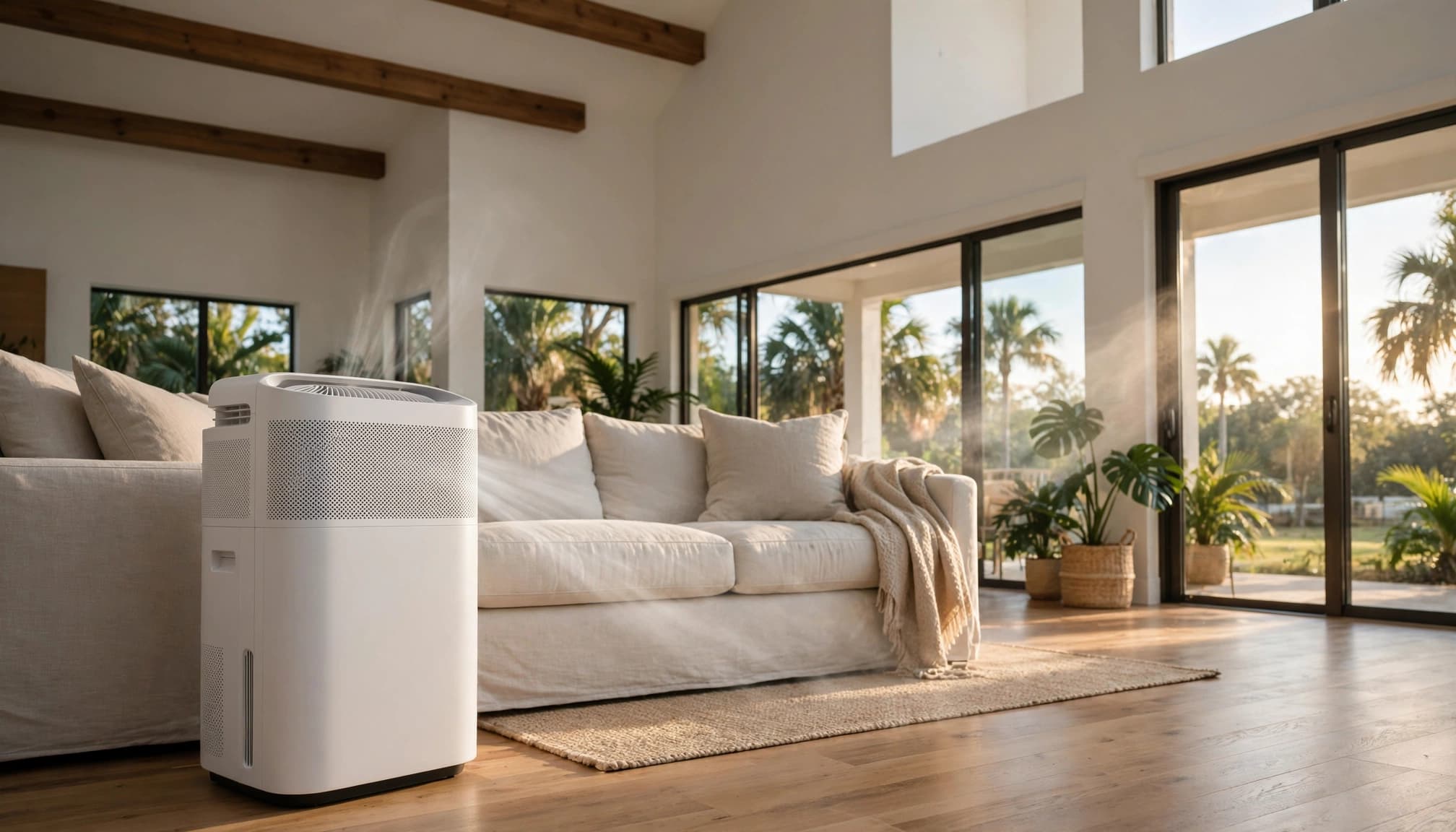
Start with the room where you'll use the purifier most. A bedroom with a door is easier to size than an open living area connected to a kitchen and hallway. In an open plan, the purifier may need to treat more than the space immediately around it.
Account for Ceiling Height
Floor area tells you how much space a room covers, but ceiling height affects how much air it contains.
For example, a 200-square-foot room with a 10-foot ceiling contains more air than a room with the same floor area and an 8-foot ceiling. The taller room needs a higher CADR to achieve the same rate of air cleaning.
Manufacturer room-size recommendations can be useful, but look at the ceiling height and air-cleaning rate behind the claim. A square-footage figure alone doesn't tell you the whole story.
Choose an Air-Cleaning Rate
Air changes per hour, often shortened to ACH, describes how many times a volume of air equal to the room's volume is cleaned in an hour. For a portable purifier, this is an equivalent air-cleaning rate , not fresh outdoor air entering the room.
If you want more air changes per hour in the same room, you'll need a higher CADR. For example, a four-air-change target requires more clean air delivery than a two-air-change target.
Use the manufacturer's room-size guidance for your desired rate, rather than comparing the largest advertised room size by itself. Different room-size claims may assume different air-cleaning rates.
Consider the Fan Speed You'll Use
The advertised CADR is typically measured at the purifier's highest fan speed. If that setting is too loud for sleeping or watching television, you may run the unit at a lower speed.
Lower speeds generally deliver less clean air. A purifier with capacity to spare can give you more flexibility, although the exact CADR at a quieter setting may not be listed. Noise, replacement-filter costs, and energy use all matter when the unit needs to run for long periods.
Keep the intake and outlet clear of furniture and curtains. A purifier tucked behind a sofa has less room to circulate air. Follow the manufacturer's replacement schedule as well, since a loaded filter can affect airflow and performance.
What CADR Doesn't Tell You
Gases, Odors, and Fresh Air
Particle CADR doesn't measure removal of volatile organic compounds, or VOCs. Activated carbon can capture some gases and odors, but results depend on the chemical and the amount and type of carbon media.
Our guide to carbon filters for VOCs and odors explains those limits. A particle purifier also doesn't bring in outdoor air or lower indoor carbon dioxide the way effective ventilation can.
In humid Southwest Florida, ventilation needs planning because outdoor air can add moisture and heat. An energy recovery ventilator can exchange indoor and outdoor air while transferring some heat and moisture between the air streams. The right setup depends on the home.
Humidity and Mold Sources
An air purifier doesn't dehumidify a room or fix a moisture problem. It can remove some airborne mold spores, but it won't correct a leak or remove growth on a damp surface.
Use bathroom exhaust during showers and kitchen exhaust while cooking to remove moisture and pollutants near their source. Persistent musty odors or visible growth call for attention to the underlying cause.
How CADR Relates to Your HVAC Filter
A portable purifier's CADR and an HVAC filter's MERV rating describe different things. CADR measures a portable unit's particle-cleaning delivery rate. MERV describes how effectively a filter captures particles of different sizes.
A higher-MERV filter isn't automatically right for every air conditioner. The filter and system need to work together so the blower can maintain adequate airflow. Our guide to how filter ratings affect HVAC airflow covers that balance.
Portable units can supplement central filtration in a room where you spend time. If you want treatment across the house, whole-home air purifier options depend on the equipment and ductwork already in place.
Choose for the Room You Use
A useful CADR gives your purifier enough particle-cleaning capacity for the room's volume and your preferred air-cleaning rate. Ceiling height and the fan speed you'll live with matter as much as floor area.
For help with your home's HVAC airflow or indoor-air concerns, Contact Us to schedule a service call.